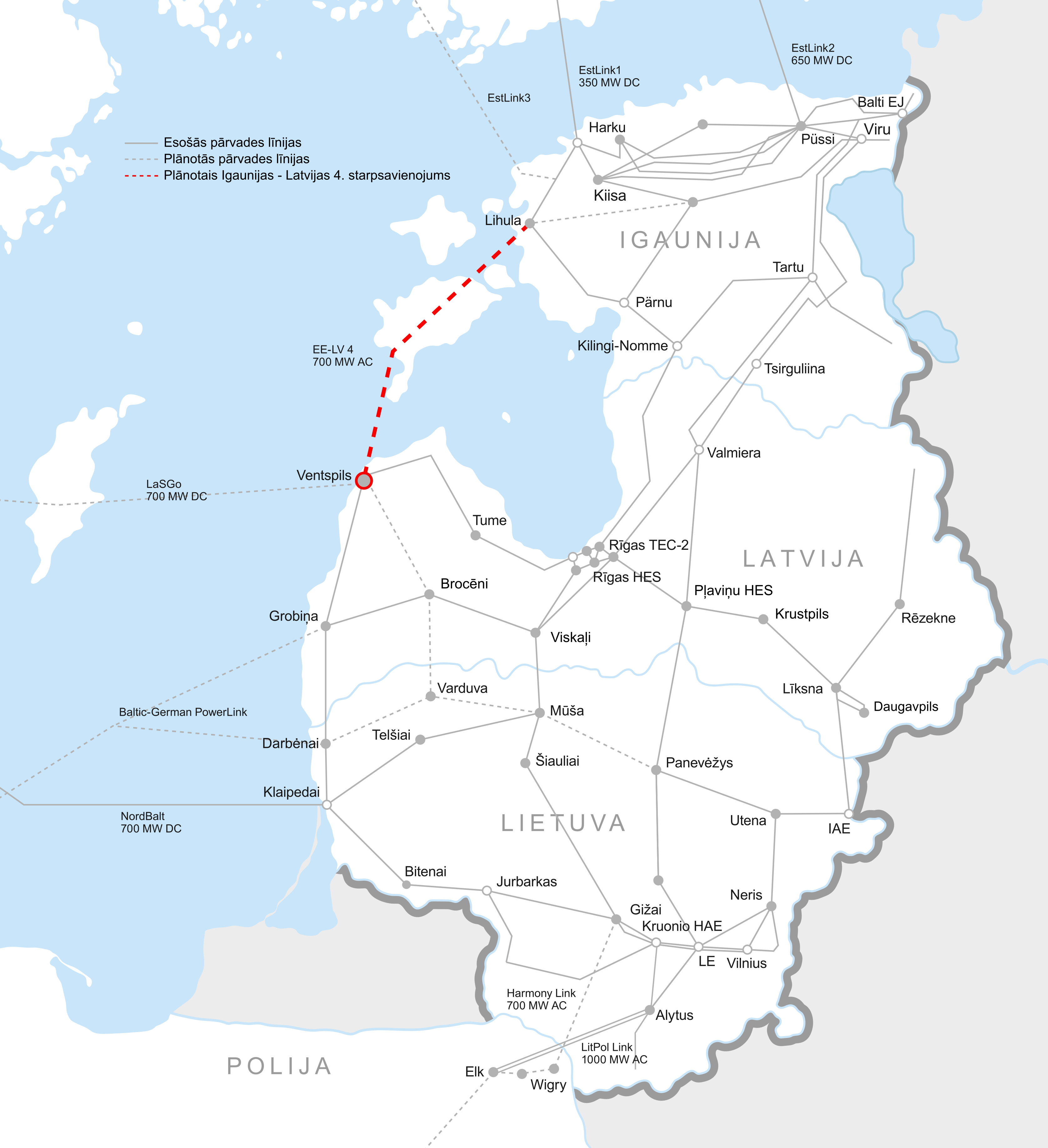
The fourth Estonian-Latvian electricity interconnection project consists of the construction of a high-voltage submarine cable connection between Saaremaa Island (Estonia) and Kurzeme region (Latvia), as well as the onshore part from the shore to the existing electricity transmission networks of Latvia and Estonia. The planned capacity of the interconnection is expected to be 700 MW. The project will be implemented using high-voltage alternating current (HVAC) technology.
Project events
The development of the fourth Estonia-Latvia electricity interconnection will significantly increase the reliability…
To increase transmission capacity between Estonia and Latvia and to support the development of renewable energy…
The project is being implemented by AS "Augstsprieguma tīkls" together with the Estonian transmission system operator AS "Elering". The project is currently in the planning and development phase, with the preparation of necessary studies and analyses for future development decisions. The technical design and implementation of the interconnection will be finalized during the feasibility phase of the project.
In 2025, technical and economic feasibility studies for the project were started. Technical study is finalised and economic study is expected to be finalised in 2026. The next important step is environmental impact assessment of the project.
The project has cross-border significance at the Latvian, Estonian, and European levels. It is included in strategically important development documents in Latvian and European levels, e.g., the Latvian Power Transmission System 10 years Development Plan, the Latvian Transmission System Operator’s Annual Statement, the European 10 Years Network Development Plan (TYNDP), the list of Projects of Common Interest / Projects of Mutual Interest (PCI/PMI) and others. All these activities will give possibility to attract European Union co-financing for the project in the future.
To ensure the secure and stable operation of the project, it is also necessary to reinforce the internal 330 kV electricity transmission network in both countries. For the secure and stable operation of interconnection, the 330 kV transmission line Ventspils–Brocēni–Varduva is being developed in Latvia, and the 330 kV transmission line on Saaremaa is being developed to connect the project to the Estonian 330 kV transmission network.
The 4th interconnection between Estonia and Latvia will significantly increase transmission capacity between both countries. The operation of interconnected power systems is essential to provide a reliable, secure and efficient power supply, what is extremely important in the Baltic synchronisation mode with continental Europe.
New interconnection also provides efficiency of electricity market development in both countries. In the Baltic region, Latvia and Estonia are currently connected by three 330 kV overhead interconnections. However, the growing interest in renewable energy connections to the transmission network and the increasing need for cross-border electricity exchanges require additional transmission capacity.
In this context, the development of the fourth interconnection between Estonia and Latvia is a strategic priority to increase system flexibility, increase security of supply, and support the large-scale integration of renewable energy sources to the transmission network, particularly offshore wind projects in the Baltic Sea, which are expected to contribute to lower electricity prices in Latvia and Estonia.
In June 2026, the technical study, asked by AST and Elering and prepared by the Italian energy consultant CESI S.p.A. confirmed that the construction of the fourth Estonia-Latvia interconnection will significantly increase the security of supply of the Baltic Sea region and will also facilitate the integration of larger volumes of renewable energy into the transmission network. The study included modelling of network security and stability, as well as the interconnection impact to the electricity transmission systems of both countries, considering the development trends of both countries’ systems and the increasing share of renewable energy.
The consultant proposes implementing the interconnection as 275 kV high voltage alternating current (HVAC) solution due to the relatively short length of the offshore route – approximately 100 km. The interconnection will consist of two three-phase cables providing interconnection capacity around 700 MW.
As part of the study, a preliminary route survey of the interconnection was prepared for the sea and to the nearest onshore substation in each country. The study analysed and proposed the most environmentally friendly route for the interconnection, taking into account environmental protection zones and the specific characteristics of maritime spatial planning.
An Environmental impact assessment (EIA) procedure has been initiated for the project in accordance with the Latvian Law on Environmental Impact Assessment).
Within the framework of the EIA, a comprehensive assessment will be carried out to evaluate the potential impact of the proposed activity on natural areas, protected bird, animal and plant species, as well as other environmental values. The project's impact on local residents and their properties will also be assessed, and both the benefits and potential drawbacks of the project will be examined.
The EIA will be conducted in compliance with all applicable legal and regulatory requirements, while taking into account the interests of all potentially affected and involved stakeholders and institutions.
Both onshore and offshore, the cable route will be planned to avoid adverse impacts on the environment, natural values and the ability to carry out other economic activities.
EIA of the project was started on February 23, 2026, when AST submitted the initial environmental assessment application to the State Environmental Service (SES) for the preliminary assessment of the environmental impact of the proposed interconnection. SES did the preliminary assessment (No. AP26SI0066) and, on March 23, 2026, issued the decision on the necessity to prepare full EIA for the proposed activity. On March 25, 2026, SES issued Decision No. 11.17/AP/2922/2026 on the application of the cross-border environmental impact assessment procedure for the "Fourth Estonia–Latvia Electricity Interconnection". As the project may have cross-border environmental impacts, in accordance with environmental legislation, the materials were submitted to the competent environmental authority in Estonia.
The initial public consultation of the planned Estonia-Latvia interconnector was organised from May 22 to June 30, 2026. Two public discussion meetings were organized in impacted municipalities to inform the public about the planned project development. The presentation from the public discussions meetings can be found here.
According to national legislation, on July 6, 2026, AST submitted all public discussions materials and written request to the State Environmental Service to issue an environmental impact assessment Program for the planned 4th interconnection between Estonia and Latvia. The EIA Programfor the 4th Estonian-Latvian electricity interconnection development in the territorial waters of Latvia in the Baltic Sea, in Ventspils and Ventspils district was issued on July 21, 2026.
The public procurement for EIA study and selection of EIA consultant will be organised at the end of 2026.
The project costs will be determined during the next steps of the project. The project is expected to receive European Union co-financing from the Connecting Europe Facility (CEF) fund, the same as was done for other AST network infrastructure development projects. The planned co-financing will be used for project studies, design, and construction.
The transmission system operators of both Latvia and Estonia have completed all necessary preparatory works to include the project in national and European Union development documents, which is a precondition for receiving co-financing.
The Project is planned to be implemented until 2035.
October 2025: Launch of the feasibility study to assess options for developing the interconnection.
23 February 2026: AST submitted an application regarding the proposed activity to the Environmental State Bureau.
23 March 2026: The Environmental State Bureau decided to initiate the Environmental Impact Assessment (EIA) procedure.
June 2026: Initial public consultation meetings were conducted.