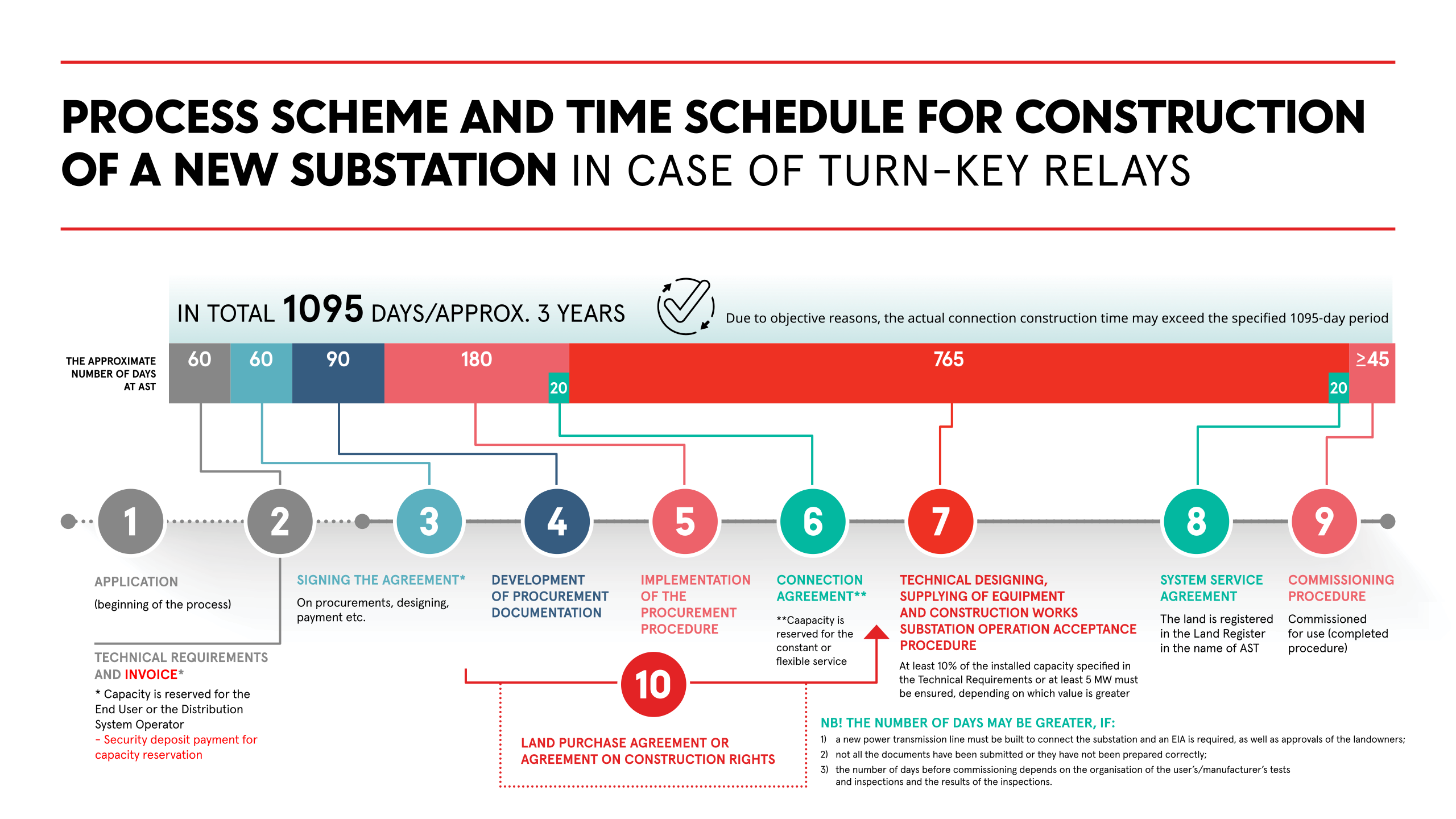
As an electricity transmission system operator (TSO), AS Augstsprieguma tīkls has a permanent obligation, subject to the scope and term of its licence, to ensure the network members have the necessary connections to the transmission system or the necessary changes to the permitted capacity of the existing connection consistently with the regulations issued by the Public Utility Regulatory Commission (the Regulator):
The users of the electricity transmission system are required to comply with Commission Regulation (EU) No. 2016/1388 of 17 August 2016 on establishing a network code on demand connection.
Electricity producers must comply with the requirements of the Commission Regulation (EU) of 14 April 2016 establishing a network code on requirements for the grid connection of generators.
Electricity producers must obtain a permit for the introduction of a new electricity generation facility or the increase in electricity generation capacity in accordance with the Electricity Market Law (Elektroenerģijas tirgus likums) – hereinafter referred to as the EML, Chapter VI, Introduction of New Capacity, Section 22, from the relevant office, in accordance with Cabinet Regulation No. 821 ( Noteikumi par atļaujām jaunas elektroenerģijas ražošanas iekārtas un elektroenerģijas uzkrātuves ieviešanai vai elektroenerģijas ražošanas jaudas palielināšanai)"Regulations on Permits for the Introduction of a New Electricity Generation Facility or the Increase in Electricity Generation Capacity".
The methodology for calculating the security deposit in the electricity sector is determined by: Decision No. 1/21 of the Council of the Public Utilities Regulatory Commission (Riga, October 9, 2025 (No. 38, Article 3)): Methodology for calculating the security deposit in the electricity sector(Drošības naudas aprēķina metodika elektroenerģijas nozarē); Decision No. 115 of the Council of the Public Utilities Regulatory Commission: On the security deposit per unit of capacity reservation in the electricity sector (Par drošības naudu par vienu jaudas rezervēšanas vienību elektroenerģijas nozarē).
The calculation and application procedure of tariff discounts for the electricity transmission system service is carried out in accordance with: Decision No. 1/11 of the Council of the Public Utilities Regulatory Commission in Riga on October 31, 2024 (No. 44, p. 5) Elektroenerģijas pārvades sistēmas pakalpojuma tarifa atlaides aprēķināšanas un piemērošanas kārtība
Electricity producers and electricity users must comply with the requirements of the Network Code for the Electricity Sector
Under the procedure prescribed by the Cabinet, the end-user has the right to submit an application for special connection to the transmission system or for increasing the connection capacity of the existing transmission system if after the installation of the connection the user’s electricity consumption will increase by at least 100,000 megawatt hours per year or with a nominal capacity of the connection of at least 50 megawatts. Cabinet Regulation No. 476 “Regulation on Special Connection to the Electricity Transmission System”
If you are interested in connection possibilities to the electricity transmission system, the Electricity producers and the Users are kindly requested to get acquainted with the changes to the Electricity Market Law (changes entered into force on 1 April 2025). In accordance with the amendments, the available Generation capacities of the constant service are shown on the map available below, and the Generation capacities of the flexible service are shown in the Flexible service offer. The map of available capacities is for informational purposes only. For connection options, please contact AS "Augstsprieguma tīkls" individually.
Flexible service free capacity offer 01.09.2026. PDF file
IMPORTANT INFORMATION!
AS “Augstsprieguma tīkls” would like to inform you that due to amendments to the Electricity Market Law (which took effect on 1 April 2025) and in accordance with Section 123 of the Transitional Provisions, ‘By 31 December 2026, free transmission system capacity is only allocated for the provision of the flexible transmission system service to electricity producers. If free transmission system capacity is allocated for the introduction of a different type of power-generating facility as part of an existing connection, the flexible transmission system service is provided to all facilities with different types of generation.’
Further information:
1. According to Section 16.4(1) of the EML, constant service or flexible service is only possible for electricity storage facilities in combination with the corresponding service provided to an electricity producer. Only the limitable transmission system service is available to separately connected electricity storage facilities.
2. In choosing the connection location for an electricity storage facility, one must take the available User’s free electricity capacity that is necessary for charging the electricity storage facility into account. Depending on whether electricity capacity is available to Users on the free capacity map, it may be possible, in terms of charging, to install a connection for electricity storage facilities in the respective segments.
Free system capacity for the constant service for production and consumption connections
The free system capacity map for constant service connections is temporarily unavailable. We are working together with our partners to restore its functionality as soon as possible
Information in text format:
Available capacity in the transmission network for consumers (18.08.2026) – PDF file
Status of connection installation and permitted capacity changes
Important! The capacities available for the electricity consumption and generation constant service shown on the map are modelled according to the parameters for the reliable operation of the network. The constant service capacity available for connecting power plants is calculated for every power line, taking into account not only the capacity of the line in question but also the ability to transmit electricity further, and often not only to the nearest substations but also to those further away, in line with the consumption pattern of each substation’s clients. Because of this, situations may arise in which not a single generator is connected to a line, but there is no free capacity for generators because the nearest substation does not have sufficient consumption, and there can be opposite situations, whereby additional generation capacity can be connected to the line because there are large electricity consumers nearby.
Flexible transmission system service
Flexible service free capacity offer 01.09.2026. PDF file
Steps to install connections
The change of the technical parameters of the connection coincides with the process of installation of the connection.
Prior to the preparation of the application, the System User must evaluate the place of connection, considering the budgeted capacity in the long term as well as electricity costs, considering the connection tariff (rate). The System Users with a capacity of up to 10MVA mainly choose to install connections to the electricity distribution system, whereas a higher capacity connection can be budgeted for the electricity transmission system.
Prior to the preparation of the application we encourage you to discuss the possible connection solutions. Please email: [email protected] regarding your preferred timing of the meeting with the company's specialists concerning the installation of the connection
The application with documents must be submitted in electronic format by sending to the e-mail address: [email protected]. The application and documents must be signed with a secure electronic signature.
For the system users:
- For the connection of the system user to the electricity transmission system or for changing the technical parameters of the existing connection
- Application for the installation of a special end-user connection to the transmission system
- Appendix No. 9 to the system user application: For applicants for the flexible transmission system service
The technical specifications shall be issued to system users within 60 days of the date of receipt of their application. The system operator sends a letter to the system user with the Technical Requirements and fee calculation for the reserved capacity of the system.
If the development of the technical specifications is complex and takes longer to prepare it or if the user has failed to provide all the necessary information to the system operator, the system operator shall notify the system Uuer in writing about the deadline for issuing the technical specifications.
Complicated cases:
- The development of technical requirements (TR) must provide for the reconstruction of at least one substation or several sections of one power transmission line or several lines.
- Regardless of the type of transmission system service requested, the applicant's requested capacity exceeds 450MW.
- Within 15 days from the receipt of the first application, applications are received (regardless of the type of transmission system service requested), in the planned technical requirements of which the technical solution for the connection is interconnected.
- Within 15 days from the receipt of the first application, more than 5 applications have been received for the flexible service in one sector.
- It is desired to connect a producer and/or user and/or storage facility at one connection point.
- If several solutions are possible for the installation of the connection and their coordination with the involved parties on which the technical solution for the connection depends, including the possibility of the connection, must be carried out.
- Any other case where the technical solution for the connection is objectively considered to be complex or different from the standard technical solution (AST, when issuing a letter on the status of the complex case and the extension of the deadline for developing technical requirements, provides justification for compliance with this point).
Indicative costs of connection construction (updated on 07.05.2025):
| No. | Anticipated works | Voltage (kV) | Costs, millions of EUR |
|---|---|---|---|
| 1 | Construction of a new double busbar scheme substation (5 bays) | 330 | 7.8 |
| 2 | Construction of a new connection in an existing double busbar scheme substation (1 bay) | 330 | 1.6 |
| 3 | Construction of overhead power line 1km (single-circuit version) | 330 | 0.5 |
| 4 | Construction of overhead power line 1km (double-circuit version) | 330 | 0.7 |
| 5 | Cable line construction 1km | 330 | 1.6 |
| 6 | Construction of a new H-type substation (4 bays) | 110 | 4.2 |
| 7 | Construction of a new H-type substation (3 bays) | 110 | 3.6 |
| 8 | Construction of a new double busbar scheme substation (6 bays) | 110 | 5.4 |
| 9 | Conversion of an existing H-type substation to a double busbar scheme substation (6 bays) | 110 | 5.4 |
| 10 | Expansion of an existing H-type or double busbar scheme substation (additional 1 bay) | 110 | 1.2 |
| 11 | Construction of a new simplified substation (1 bay, TSO building-container) | 110 | 1.4 |
| 12 | Construction of overhead power line 1km (single-circuit version) | 110 | 0.3 |
| 13 | Construction of overhead power line 1km (double-circuit version) | 110 | 0.4 |
| 14 | Cable line construction 1km | 110 | 1.4 |
The table shows indicative costs and is subject to change. Exact connection costs are determined during procurement procedures.
(Elektroenerģijas tirgus likuma 9.1 ) Article 9.1 of the Electricity Market Law. Security deposit for system capacity reservation: determines the procedure in which cases the System User pays a security deposit for system capacity reservation.
The methodology for calculating the security deposit in the electricity sector is determined by: Decision No. 1/21 of the Council of the Public Utilities Regulatory Commission (Riga, October 9, 2025 (No. 38, Article 3)): Security deposit calculation methodology in the electricity sector (Drošības naudas aprēķina metodika elektroenerģijas nozarē)
According to Decision No. 115 of the Council of the Public Utilities Regulatory Commission: On the security deposit for one capacity reservation unit in the electricity sector (Par drošības naudu par vienu jaudas rezervēšanas vienību elektroenerģijas nozarē): security deposit for one capacity reservation unit 20852.40 euros per megawatt.
The agreement is a document entered into between the TSO and the system User, which describes the responsibilities and accountability of the TSO, the system User; specifies who will arrange the procurement procedure, initiate construction, what the payment terms are, as well as describes many other connection related matters to be mutually resolved (such as the land development right, equipment specifications, etc.).
Sample agreement: with producers for flexible service – can be found here (in Latvian).
Sample agreement: with electricity storage system operators (BESS) for restrictive service – can be found here (in Latvian).
Please refer to the full flow chart below and step 10 of the parallel process for real estate issues for the system User .
When planning the selection of a construction merchant and equipment supplier for the installation of a connection (or modification of technical parameters), it is necessary to observe the general requirements set by AS Augstsprieguma tīkls for the construction merchants and equipment suppliers. The general requirements may be supplemented by other requirements, considering the scope and specifics of a particular project.
Construction merchants and equipment suppliers (if the equipment supplier is not mentioned in the requirements listed below, the requirements do not apply to the equipment supplier) shall meet the following general requirements:
- The construction merchant is registered in the Register of Construction Merchants;
- An ISO 9001 or equivalent certificate or other evidence of the equivalent quality assurance measures has been issued to the construction merchant and equipment supplier;
- An attested copy of the Eco-Management and Audit Scheme (EMAS) or equivalent certificate, or ISO 14001 or equivalent certificate submitted, or other evidence submitted by the Candidate regarding the implementation of equivalent quality management measures or compliance of the operation with the environmental protection requirements has been issued to the construction merchant and equipment supplier;
- Conditions for the exclusion specified in Parts 1 and 2 of Section 48 of the Law on the Procurement of Public Service Providers do not apply to the construction merchant and equipment supplier;
- During the last 2 (two) reporting years, the annual net turnover of the construction merchant and equipment supplier is not less than 80% of the amount of the planned project (the sum of the total costs of connection installation or modification of technical parameters);
- During the last 5 (five) years, the construction merchant and equipment supplier have had experience in the construction or reconstruction of 110 kV and/or higher voltage energy supply objects, as well as in the supply of goods;
- The construction merchant shall be able to certify that it will provide a sufficient number of suitably qualified personnel for the performance of the work (certified designers and construction workers, examiners, author supervisors, etc.);
- The remuneration of the personnel of the construction merchant shall correspond to at least 80 % of the level of the average hourly tariff rate published by the SRS in the specific group of professions;
- The construction merchant and the equipment supplier are not included in any sanction list binding on Latvia.
In accordance with the concluded agreement, the TSO develops procurement documentation for procurement. For the TSO part, the TSO prepares the design task for the design work, the technical specifications for the delivery of the equipment, the technical task for the contractor and other documents (regulations, contracts, etc.).
In accordance with the concluded agreement, all necessary procurement procedures are performed.
The connection contract shall be concluded when all procurement procedures have been completed and all costs are known.
After concluding the connection agreement, the TSO concludes agreements with the winners of the procurement procedure (for the part of the TSO), regardless of who has performed the procurement procedure.
In accordance with the concluded agreements, the design and construction of the connection, as well as the delivery of equipment are performed.
Two commissioning procedures are conducted once construction is completed:
1. AS “Augstsprieguma tīkls” performs the commissioning of the AS “Augstsprieguma tīkls” part of the new connection. This requires the conducting of load tests, so the system user must supply at least ten percent (10%) of the installed capacity specified in the technical requirements, or at least 5 MW, whichever is greater.
2. The power plant must be commissioned in accordance with the procedure specified in the description of Step 9.
Users:
A system service agreement is concluded before the inspections and tests are performed. The tests and inspections shall be performed in accordance with Commission Regulation (EU) 2016/1388 of 17 August 2016 establishing a Network Code on Demand Connection and the Network Code.
Producers:
A system service agreement is concluded before the inspections and tests are performed. The tests and inspections shall be performed in accordance with European Commission Regulation 2016/631 of 14 April 2016 establishing a network code on requirements for grid connection of generators and the Network Code.
To establish the procedure for the operation notification procedure for the type D electricity generation modules, demand installations and distribution installations and to make it publicly available in accordance with the requirements of Regulation 2016/631 and Regulation 2016/1388.
During the connection installation process, there are two commissioning procedures: commissioning of the AST electrical device (AST substation, EPL) and commissioning of the System User electrical device.
According to the procedure of the agreement concluded between AST and the system user, the three-year construction period is considered fulfilled if the following conditions are met:
- The system user has received an interim operational notification (ION);
- AST has commissioned its electrical equipment (AST substation, OHL);
- An act of the building board has been received on the acceptance of the AST electric device into operation;
- 72h overall test of AST electrical device and Producer/User/DSO connection acceptance is successful.
Procedures for the Operation notification and Procedures for performing inspections
If the installation of the connection is linked to the construction of a new JSC "Augstsprieguma tīkls" substation or a part of it, then the installer of the connection shall provide the plot of land necessary for the substation or its part (hereinafter - Land):
- Prepare and coordinate with the AST substation unit or part thereof with borders and planned electrical equipment position;
- Prepared and registered with the State Land Service for the Border Plan or Scheme of the Earth Unit;
- before the initiation of construction, a building rights agreement must be concluded, which stipulates the obligation of the landowner to allocate the land necessary for the construction of the substation and expropriate it in favor of AST for the cadastral value, or a sale transaction for the land necessary for the construction of the substation for the cadastral value must be concluded for the AST, if the land necessary for the construction of the substation is prepared for expropriation and meets for the planned location of the substation;
- if a building rights agreement is concluded with the right to expropriate the land necessary for the construction of the substation, the land purchase agreement must be concluded before the conclusion of the system service agreement;
- Timely preparation and coordination of the land unit of the land unit or the scheme with AST, the preparation of the land management project for the distribution of the land property and the separation of the AST substation for separation of the land unit;
- Prepare land boundary plans for land units provided for in the land use project;
- must be concluded by AST land purchase agreement and registered in the Land Register;
- Prepare a road servitude scheme for the driveway to the AST substation;
- a servitude agreement with AST and registered in the Land Register.
The planned substation and power line location provide the maximum height of the wind power plant (including the length of the rotor wings) plus 10 meters.
We advise to address issues related to Land as soon as the first agreement has been singed (Step 3).
The construction right agreement or land expropriation agreement must be concluded and registered in the land register before the initiation of construction (step 4).
The registration of property rights in the name of JSC "Augstsprieguma tīkls" must be finalised before the conclusion of the System Service Agreement (Step 8).